Our Handicrafts Collection

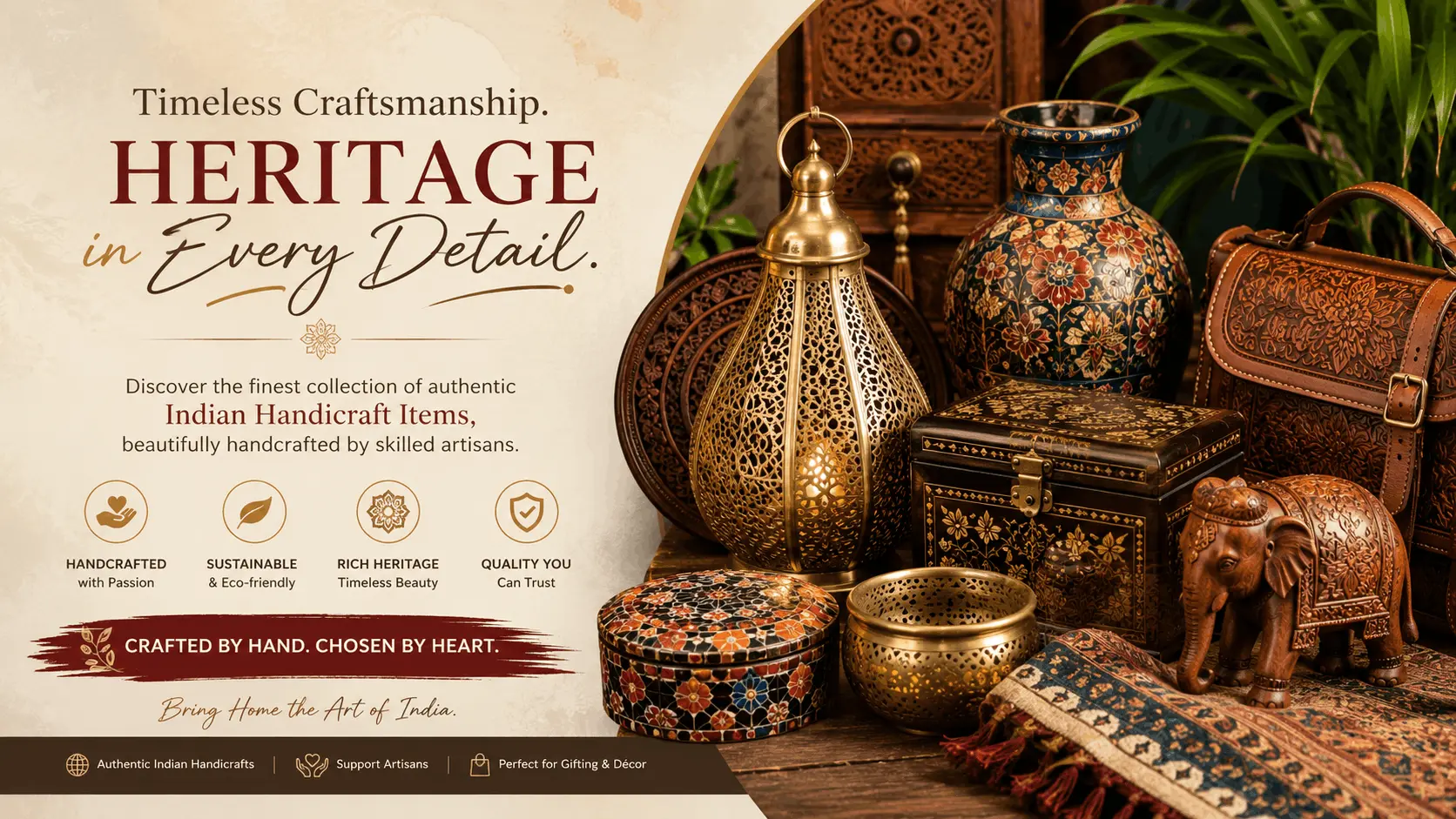
After understanding the client’s requirements, we provide product samples for quality evaluation, enabling confident and... informed purchasing decisions. Read More
After evaluating the samples, the client confirms the order, following which 50% of the total payment is to be made to initiate... the production process. Read More
Next, the products are manufactured under strict quality standards, ensuring consistency, compliance and timely production.
Next, we perform export-standard packaging with complete transparency and quality assurance. The entire packaging... process is recorded and shared with the client. For exports by air and road, the remaining 50% payment is required at this stage before shipping. Read More
Next, we ship the packages through trusted logistics partners and share scanned copies of all necessary export documents with... the client via email. For sea shipments, the remaining 50% payment is to be completed upon receiving the scanned documents. Read More
Next, we courier the original copies of all required export documents needed for customs clearance and import procedures... in the client’s country. This step is especially important for sea shipments. Read More
We kindly request our clients to record the cargo opening process from start to finish, as the footage may be required for... verification purposes in the event of any discrepancies or insurance claims. Read More
We request our clients to please contact us in the event of any discrepancies and allow us the opportunity to resolve the matter... promptly and professionally. Read More
We collect client feedback to evaluate satisfaction, enhance our services, and build long-term business relationships.
20/10 Northern Avenue, Kolkata - 700037, India
Walk through a good handicraft store and you will notice something that is difficult to reproduce with ordinary mass produced merchandise. Products have personality. A carved wooden box may show small differences in its surface. A woven basket may have its own pattern. A brass object can carry the marks of the craft process. These details are often what make customers stop, pick something up and take a closer look.
India has an unusually broad craft base. Different regions have developed their own materials, techniques and styles, from wood carving and metalwork to textiles, natural fibres, pottery, jewellery and decorative products. For an overseas buyer, this creates plenty of choice without limiting a collection to one particular look.
Trade Horizon helps businesses explore handicraft sourcing from India for retail, wholesale, hospitality, interior projects and other commercial requirements.
The opportunity in handicrafts is not simply about buying something attractive from India. The product has to make sense for the market where you intend to sell it.
A boutique may want smaller pieces with an easy retail price. A home décor business might be looking for larger decorative products. A hotel could need hundreds of matching or complementary pieces. An online retailer may be more concerned about product size, packaging and shipping costs.
This is why the starting point should be your requirement.
If you already have a product in mind, you can share photographs, dimensions, materials or a reference sample. If you are still exploring, you can describe your business and the type of customers you serve. That gives the sourcing discussion somewhere useful to begin.
The range available through handicrafts export from India is much broader than many first time buyers expect. Indian suppliers work with wood, metal, stone, marble, clay, textiles, natural fibres and other materials to create products for homes, gifting, hospitality and retail.
You may find traditional pieces that carry a strong regional identity, or products with simpler designs that fit easily into contemporary stores. There is also room for custom requirements where the product, quantity and production capabilities make it practical.
The Government of India identifies several major overseas destinations for Indian handicrafts, including the USA, UK, Germany, UAE, France and Italy. Export categories include woodware, art metalware, hand printed textiles and embroidered and crocheted goods.
Not every attractive handicraft is automatically a good commercial product.
Consider how it will be displayed, who will buy it and what they are likely to pay. A beautifully detailed piece may work well in a premium store but be difficult to sell in a price sensitive retail chain. A smaller item may be easier to ship and display, while a larger decorative piece can create more impact in a hotel or interior project.
The material matters too. Buyers should think about durability, maintenance, weight and the conditions in which the product will be used.
Trade Horizon can help overseas buyers explore options around these practical considerations instead of treating product selection as a purely visual exercise.
The phrase handicraft items export from India covers a large collection of products. Depending on the requirement, buyers can explore home décor, furniture, baskets, trays, boxes, sculptures, pottery, textiles, jewellery, metal articles, leather products and other handmade goods.
For a retailer, building a connected collection can often be more useful than ordering unrelated products. Similar colours, materials or design influences can bring different products together and make the range easier to present.
A wholesaler may approach the category differently, focusing more closely on repeat availability, quantities and pricing. Hospitality buyers may need products selected around a particular interior concept.
There is no single buying model. The right approach depends on the business.
A first order does not always have to be large. Some buyers prefer to test a few products, see how customers respond and then expand the range.
Samples can be particularly helpful before a larger purchase. They allow you to inspect the actual workmanship, dimensions, colours and finish. With handmade products, this is useful because photographs cannot always show the small variations that occur from one piece to another.
If a product performs well, repeat supply becomes important. It is worth discussing expected quantities and the possibility of producing the same or similar designs again before building the product around your business.
Different countries and customer groups can have very different expectations. Packaging, product dimensions, materials, labelling and pricing may all need consideration before an order is finalised.
For example, a decorative item intended for a specialist European retailer may be presented differently from a product being purchased by a large distributor. The same applies to hospitality projects, where quantities and delivery schedules may be more important than having a very broad product selection.
The destination market should therefore be part of the sourcing conversation from the beginning.
The United States is an important market for Indian handicrafts. Government data identifies the USA as a major destination across several Indian handicraft categories, including woodware, art metalware, hand printed textiles, embroidered goods and imitation jewellery.
Businesses planning a handicraft export from India to USA should nevertheless look beyond the size of the market. The product needs to suit the intended customer, price range and sales channel.
Packaging and product information also deserve attention. A product that works well in a physical boutique may require a different approach when sold online, particularly when shipping individual pieces to customers.
Trade Horizon helps buyers explore Indian handicraft sourcing with their destination market and commercial requirements in mind.
You do not need to know every Indian craft cluster before starting. India has established organisations supporting the handicraft export sector, including the Export Promotion Council for Handicrafts, which works to promote Indian handicrafts internationally and provides market and information facilities for exporters and importers.
What you need first is a clear idea of what you are trying to buy.
Share the product, approximate quantity, destination, preferred material, size, finish and any reference images you have. If you are still deciding, explain the kind of business you operate and the collection you want to build.
From there, suitable sourcing possibilities can be explored.
The appeal of handicraft products is ultimately connected to the customer. People buy them because they want something useful, decorative, distinctive or connected to a particular craft tradition.
For an international business, that creates an opportunity to offer products that feel less interchangeable than ordinary mass market merchandise.
Whether you are adding a few Indian products to an existing collection or developing an entirely new range, Trade Horizon can help you explore handicraft products export from India according to your commercial requirements.